
Key Takeaways
- Leaf spot disease describes a group of plant diseases that cause brown, black, yellow, tan, or reddish spots on leaves. Several different pathogens can cause similar symptoms, so appearance alone does not always provide a reliable diagnosis.
- Central Florida’s warm, humid, rainy conditions can favor many leaf diseases, particularly when foliage stays wet for extended periods.
- Removing infected leaves, improving airflow, keeping foliage dry, and avoiding unnecessary overhead irrigation can reduce disease pressure.
- Fungicide is not automatically the answer. Correct diagnosis matters because different diseases require different treatments, and some leaf spot problems are mainly cosmetic.
- Homeowners should be more cautious when spots are spreading rapidly, causing significant defoliation, affecting a valuable tree, or appearing alongside dieback, cankers, decay, or structural concerns.
- In Ocala and Central Florida, an arborist can help determine whether the problem is truly a disease or something else, such as drought stress, irrigation problems, insects, or environmental damage.
Leaf Spot disease is a common plant health problem that causes brown, black, yellow, tan, or reddish spots on leaves. It can affect ornamental plants, shrubs, trees, palms, and even turfgrass. In Ocala and across Central Florida, warm temperatures, humidity, rainfall, and prolonged leaf wetness can create favorable conditions for many leaf-spot pathogens.
The important thing to understand is that “leaf spot” is not one specific disease. Similar-looking spots can come from different fungi, bacteria, insects, or environmental stress, which is why treating the wrong problem can waste time and potentially damage the plant.
Table of Contents
What is leaf spot disease?
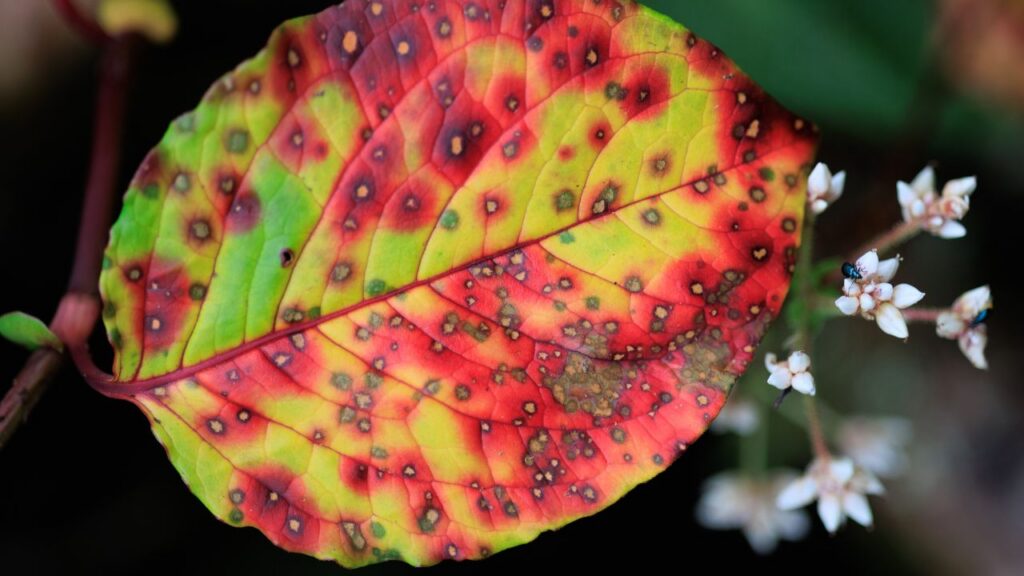
Leaf spot disease is a general term for diseases that create localized damaged areas, or lesions, on leaves. The spots may remain small and isolated or enlarge until portions of the leaf die and drop.
Different pathogens produce different patterns. Some spots have yellow halos, dark borders, concentric rings, or tan centers. Others may look water-soaked or develop tiny structures associated with fungal growth.
Why does leaf spot develop?
Leaf spot generally becomes more likely when three conditions come together:
- A susceptible plant is present.
- A disease-causing pathogen is present.
- Environmental conditions favor infection.
Moisture is particularly important for many fungal and bacterial leaf diseases. Rain, overhead irrigation, high humidity, crowded foliage, and poor air movement can keep leaves wet long enough for infection to develop.
This matters in Central Florida because our warm, humid climate can provide favorable conditions for foliar diseases during wet periods.
What does leaf spot look like?
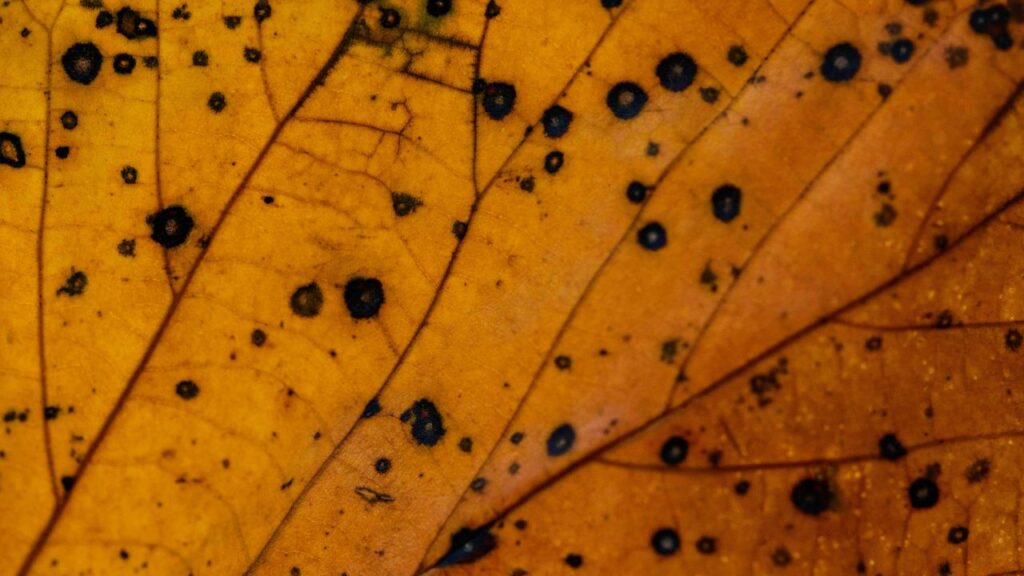
Leaf spots usually appear as individual brown, black, tan, yellow, reddish, or purple lesions that may expand or merge as the problem progresses. However, the exact appearance depends on the plant and the organism involved.
Common symptoms include:
- Small brown or black dots
- Yellow halos around spots
- Tan or gray centers
- Irregular dead areas
- Spots with darker margins
- Several spots merging into larger dead sections
- Premature yellowing or leaf drop
- Thinning foliage when infection becomes severe
Some diseases are relatively harmless to established plants, while others can cause significant defoliation or weaken a plant already under stress.
Professional insight: One of the biggest homeowner mistakes is assuming that every brown spot is automatically a fungal infection. Drought, fertilizer injury, chemical damage, insects, mites, nutrient problems, and other diseases can create similar symptoms.
That is why we look at the whole plant and growing environment, not just one damaged leaf.
What causes leaf spot disease in Central Florida?
Leaf spot can be caused by several types of fungi and bacteria, with moisture and environmental conditions often influencing how quickly symptoms develop. Different plants are susceptible to different pathogens, so the cause cannot be determined reliably from the words “brown spots” alone.
In Central Florida, disease pressure can increase when:
- Leaves remain wet for long periods
- Rainfall is frequent
- Overhead irrigation wets the canopy
- Plants are overcrowded
- Air movement is poor
- Fallen infected leaves remain beneath plants
- The plant is already stressed
- Conditions favor fungal or bacterial growth
For homeowners in Ocala, this is particularly relevant during periods of frequent rainfall and high humidity.
Good cultural practices can make the environment less favorable for disease, even when the pathogen itself cannot be completely eliminated.
Is leaf spot disease harmful to trees?
Many leaf spot diseases are primarily cosmetic on mature, otherwise healthy trees, but severe or recurring infections can cause significant defoliation and add stress to already weakened plants. The level of risk depends on the tree species, pathogen, severity, and overall health of the tree.
A few spotted leaves do not necessarily mean a tree is in danger.
For example, a mature tree may tolerate some leaf spotting and continue producing healthy new foliage. The situation deserves more attention when you see:
- Extensive leaf loss
- Repeated yearly outbreaks
- Dieback of twigs or branches
- Cankers or damaged bark
- Wilting
- Poor new growth
- Symptoms spreading rapidly
- Multiple plants becoming affected
Our recommendation: Don’t judge the health of a large tree based solely on its leaves. Look at the canopy, branches, trunk, root area, recent weather, irrigation, and overall growth.
How to treat leaf spot disease
Knowing how to treat leaf spot disease starts with identifying the likely cause and reducing the conditions that allow it to spread. Removing diseased material, improving airflow, managing irrigation, and keeping foliage dry are important first steps. Fungicides may be appropriate for some diseases but are not a universal cure.
1. Remove heavily infected leaves
Removing severely affected leaves can reduce sources of disease in the landscape. Collect fallen infected foliage rather than allowing it to accumulate beneath the plant.
For some plant diseases, infected leaves and debris can provide material from which pathogens spread during future wet periods.
Don’t strip a healthy tree of large amounts of foliage simply because you see a few spots. Excessive pruning can create additional stress.
2. Keep leaves as dry as practical
Reducing unnecessary leaf wetness is one of the simplest ways to reduce pressure from many leaf diseases. Avoid routinely spraying water over foliage, and where irrigation is necessary, apply it in a way that allows leaves to dry quickly.
In Central Florida, homeowners cannot control rainfall, but they can avoid adding unnecessary moisture through irrigation.
3. Improve airflow
Better air circulation helps foliage dry faster and can make conditions less favorable for disease development. Overcrowded shrubs and plants growing too closely together may benefit from appropriate selective pruning.
The key word is appropriate.
Removing large amounts of healthy canopy simply to “open up” a tree is not responsible tree care. Pruning should be based on the plant’s species, structure, condition, and actual need.
4. Avoid unnecessary fungicide applications
The right leaf spot disease treatment depends on the specific plant and the cause of the symptoms. Fungicides may be appropriate for some problems, but they are not a universal cure.
Correct diagnosis should come first because different pathogens require different management approaches.
UF/IFAS specifically notes that diagnosing plant disease from appearance alone can be difficult and that fungicides are designed to manage specific diseases rather than every type of leaf spot.
If treatment is warranted, the product must be appropriate for the plant and the identified disease, and the label directions should be followed carefully.
How to get rid of leaf spot disease without damaging the plant
You may be able to reduce leaf spot without chemical treatment by correcting moisture, sanitation, and airflow problems. The goal is not simply to remove today’s spots but to make the landscape less favorable for repeated infection.
Try this checklist:
- Remove severely infected fallen leaves.
- Remove badly affected individual leaves when practical.
- Avoid unnecessary overhead irrigation.
- Water at an appropriate time so foliage can dry.
- Improve spacing and airflow around crowded plants.
- Avoid excessive fertilization.
- Monitor new growth for recurring symptoms.
- Have persistent or severe problems professionally evaluated.
This approach is especially useful because not every leaf spot requires a “cure.” Some diseases are best managed by reducing severity and preventing repeated outbreaks.
When should you call an arborist?
Professional evaluation makes sense when leaf spotting is severe, recurring, spreading rapidly, or accompanied by branch dieback, decay, structural problems, or significant canopy loss. An arborist can determine whether the visible leaf symptoms are actually caused by disease or by another underlying problem.
This distinction matters because a tree with spotted leaves may actually be dealing with:
- Irrigation problems
- Drought stress
- Root problems
- Insect activity
- Nutrient deficiencies
- Environmental damage
- Fungal disease
- Bacterial disease
- Structural decline
Our approach at Native Tree of Central Florida is to evaluate the tree rather than automatically recommend treatment. If you are concerned about a tree’s health, contact our company to discuss an evaluation and determine the appropriate next step.
For larger trees, climbing, chainsaw work, or pruning near structures and utilities, homeowners should also consider the safety risks involved. Professional tree work requires appropriate equipment, training, and risk assessment.
Our team is fully insured and includes ISA-Certified Arborists, allowing us to evaluate tree health and recommend care based on the actual condition of the tree.
For homeowners looking for additional guidance, our tree health inspection resource and tree risk assessment service provide related information.
How can homeowners prevent recurring leaf spots?
The best prevention strategy is to maintain healthy plants while reducing unnecessary leaf wetness, improving airflow, and removing infected plant debris. Prevention is particularly useful in Central Florida because warm, humid weather can repeatedly create favorable conditions for foliar diseases.
A practical Ocala checklist is:
- Inspect plants regularly.
- Watch new growth for recurring spots.
- Keep irrigation targeted toward the soil.
- Avoid unnecessarily wetting foliage.
- Remove fallen diseased debris.
- Don’t overcrowd plants.
- Avoid unnecessary pruning.
- Avoid excessive fertilizer.
- Investigate recurring symptoms instead of repeatedly treating them blindly.
- Have valuable or declining trees assessed professionally.
Healthy plants are generally better able to tolerate disease pressure, making proper planting, watering, soil care, and routine monitoring part of long-term disease management.
Central Florida’s sandy soils can also influence water availability and root health, so irrigation should be considered as part of the entire landscape rather than treating leaf symptoms in isolation. Our Central Florida soil health guide covers that broader issue.
Conclusion
Leaf spots can look alarming, but they do not automatically mean that a tree or plant is dying. The most important step is determining what is actually causing the spots before deciding how to treat them.
For many cases, sanitation, better airflow, appropriate irrigation, and keeping foliage dry can significantly reduce disease pressure. Chemical treatment may be useful for specific diseases, but it should be selected based on the plant, pathogen, timing, and label requirements rather than simply because the leaves look damaged.
In Ocala and throughout Central Florida, where heat, humidity, and seasonal rainfall can influence plant disease, regular observation is one of the simplest ways to protect your landscape.
Protect Your Trees From Leaf Spot
Early treatment can help prevent leaf spot from spreading and causing further damage. Get professional tree care from our certified team to keep your trees healthy and thriving.
Call us today at (352) 561-3626 or reach us via e-mail at sales@nativetreecf.com to schedule your professional tree service.
Frequently Asked Questions
Can leaf spot disease kill a tree?
Usually, leaf spot is not enough by itself to kill a mature, healthy tree. Severe or recurring disease can cause significant defoliation and stress, particularly when the tree already has other health problems.
Can I treat leaf spots with fungicide?
Sometimes, the correct fungicide depends on the specific disease and plant. Diagnosis should come before treatment because no single fungicide works for every leaf spot problem.
Should I remove leaves with leaf spots?
Heavily infected leaves and fallen diseased debris can be removed to reduce potential sources of infection. Avoid excessive pruning of healthy branches simply because some leaves are spotted.
Does humidity make leaf spots worse?
It can. High humidity and prolonged leaf wetness favor many fungal and bacterial leaf diseases.
Is leaf spot the same as a lawn disease?
No. Leaf spots can occur on turfgrass, but lawn diseases involve different pathogens and management considerations. Turfgrass species also differ in their susceptibility and symptoms.