
Key Takeaways
- Remove dead, damaged, diseased, crossing, and poorly positioned branches before shaping healthy growth.
- Do not assume every Central Florida shrub should be trimmed into a tight ball or box.
- When learning how to trim overgrown bushes, avoid removing large amounts of healthy growth all at once unless the plant and pruning method justify it.
- Keep shrubs near homes from pressing against walls, windows, vents, and other structures.
- Formal hedges should generally be narrower at the top than the bottom so lower foliage receives adequate sunlight.
- Florida’s long growing season can mean more frequent maintenance, but frequent hard cutting is not necessarily the answer.
- Flowering shrubs need species-specific pruning because cutting at the wrong time can remove developing flower buds.
- Small, accessible shrubs can often be handled by homeowners, while tall, heavily overgrown, thorny, or difficult-to-access plants may require professional help.
To trim bushes correctly, first remove dead, damaged, diseased, crossing, or poorly positioned branches, then lightly shape the healthy growth while preserving the plant’s natural form. For hedges, keep the top slightly narrower than the base. Central Florida homeowners should also consider the shrub’s species, flowering cycle, rapid seasonal growth, and location near structures before making major cuts.
For Central Florida homeowners, learning how to trim bushes is about more than making the landscape look neat. Florida’s warm temperatures, humidity, rainfall, and long growing season can cause shrubs and hedges to grow quickly, especially around homes, walkways, driveways, and property lines. The right approach depends on the plant, its location, and how much growth needs to be removed.
Whether you are maintaining a small foundation shrub in Ocala or trying to bring an overgrown hedge back under control, this guide explains what to cut, how much to remove, when to stop, and when professional shrub trimming is the better choice.
Table of Contents
How Should You Trim a Bush?
Start by removing problem growth, then shape the remaining healthy branches gradually rather than cutting the entire shrub down to a uniform size. The goal of shrub trimming is to improve the plant’s health, appearance, clearance, and structure without removing more healthy growth than necessary.
Before making the first cut, walk around the shrub and look at it from several angles.
Identify:
- Dead branches
- Broken or damaged stems
- Diseased-looking growth
- Branches rubbing against each other
- Growth extending into walkways
- Branches touching the house
- Weak or poorly positioned stems
- Growth that is blocking windows or access areas
Once these problems are addressed, step back again.
You may find that the shrub needs less cosmetic trimming than you originally thought.
A Central Florida Consideration
Shrubs can respond quickly to pruning here because Central Florida has a long growing season. A plant that is cut aggressively simply because it looks slightly overgrown may produce vigorous new growth and require another hard trim sooner than expected.
Our professional approach is to think about the plant’s next growth cycle, not just how it looks on the day it is trimmed.
How Do You Trim Overgrown Bushes?
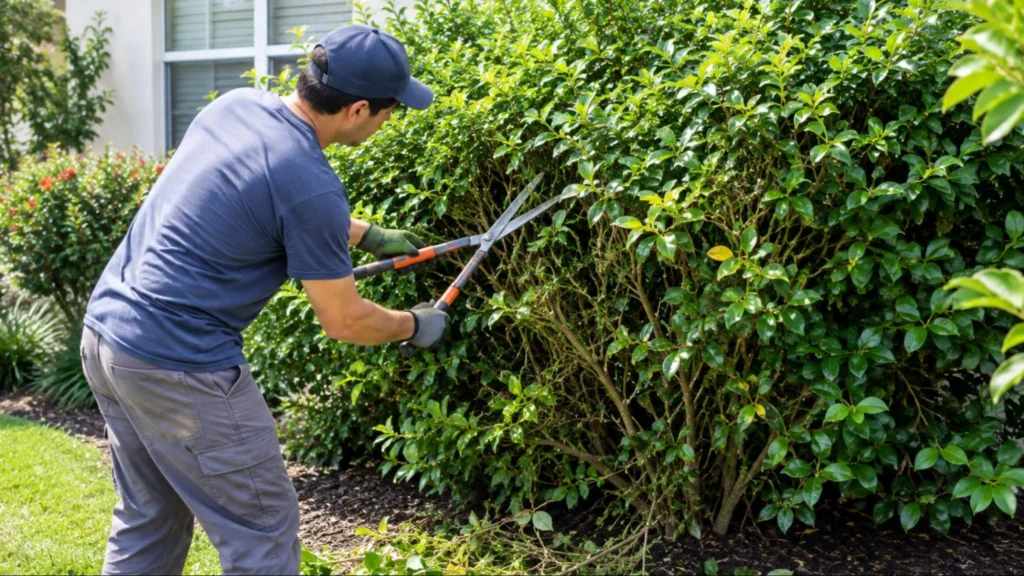
When learning how to trim overgrown bushes, avoid trying to make a severely neglected shrub look perfect in one afternoon. Selective removal and gradual reduction are often better than cutting everything back to the same height.
An overgrown shrub can be deceptively difficult to prune.
The outside may look dense and healthy while the interior has become crowded, shaded, or sparse. Simply cutting the outer surface can make the shrub smaller without actually correcting its structure.
A better approach is:
1. Find the problem stems
Look inside the plant rather than only trimming the outside. Identify older, damaged, crossing, or poorly positioned stems that can be removed.
2. Reduce selectively
Rather than cutting every branch to the same length, remove appropriate stems at their points of origin or at suitable lateral branches.
3. Step back frequently
Stand several feet away and look at the entire plant. This helps prevent the common mistake of continuing to cut simply because the trimmers are already in your hands.
4. Know when gradual pruning is better
Some severely overgrown shrubs cannot be safely or effectively restored in one session. Depending on the species and condition, staged pruning may produce a better result than drastic reduction.
Central Florida Homeowner Tip
If a shrub repeatedly becomes too large for the space, pruning may not be the real solution.
For example, a large-growing shrub planted directly below a Central Florida home’s windows may require constant cutting simply because it was planted too close to the structure.
In that situation, the long-term answer may be relocating or replacing the plant with something better suited to the available space.
How Do You Trim Bushes in Front of a House?
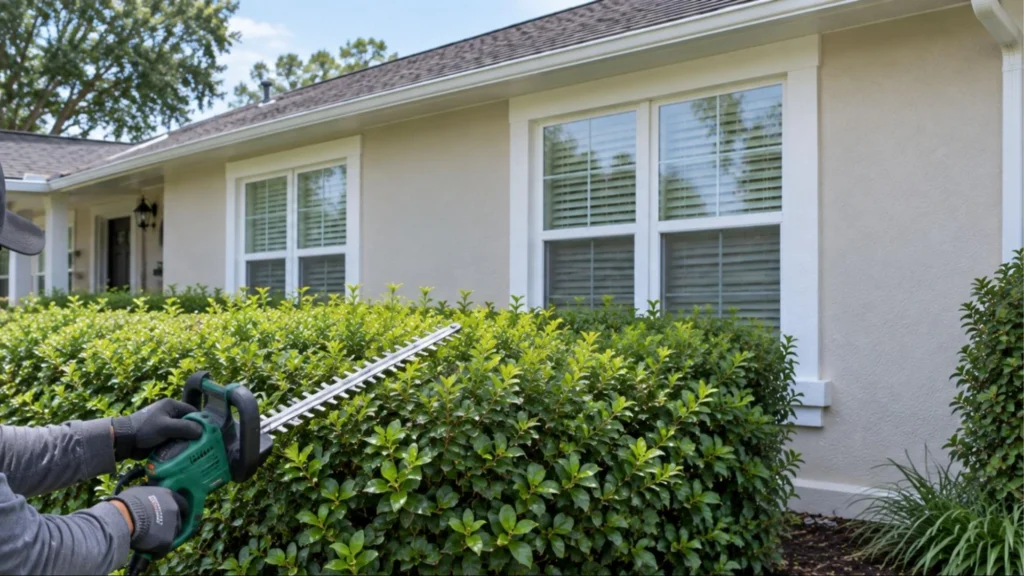
Bushes in front of a house should be trimmed to maintain appropriate clearance from the structure while preserving healthy growth and the plant’s natural shape. Avoid allowing dense foliage to press directly against walls, windows, vents, or other parts of the home.
This is especially relevant for foundation plantings around Florida homes, where shrubs may grow quickly during warm and rainy periods.
When trimming bushes in front of your house, check whether they are:
- Blocking windows
- Touching stucco or other exterior surfaces
- Covering vents
- Growing into walkways
- Blocking visibility near driveways
- Interfering with access to utility areas
- Crowding other landscape plants
- Growing beneath rooflines or other structures
UF/IFAS Florida-Friendly Landscaping guidance recommends maintaining approximately 12 to 18 inches of clearance between shrubs and structures.
That doesn’t mean every shrub on every property must be maintained at exactly the same distance. The appropriate clearance depends on the plant, the structure, and the purpose of the planting.
The important point is to avoid planting or maintaining shrubs so close that normal growth immediately puts them back against the house.
How Do You Trim Hedges So They Stay Full?
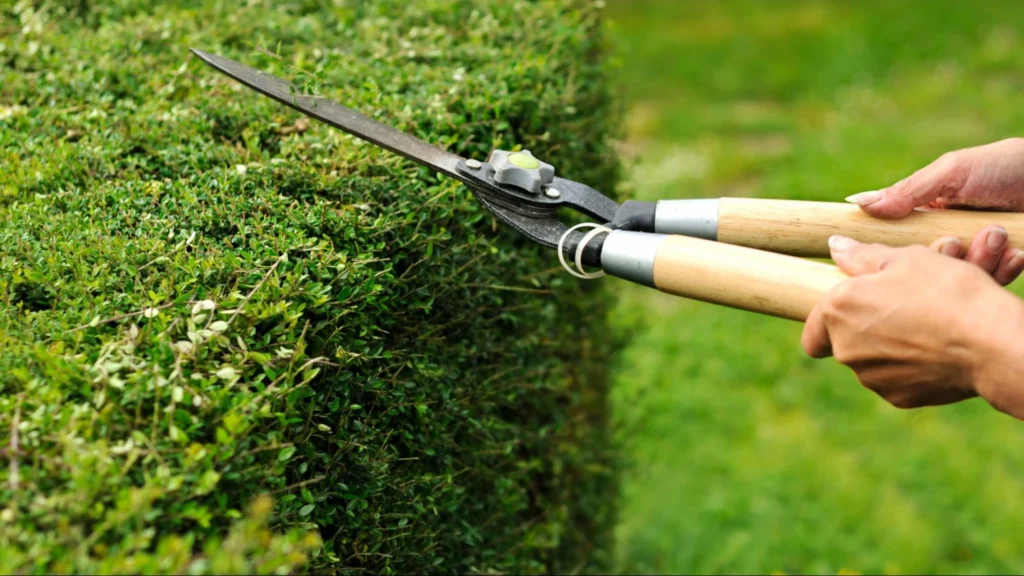
The best way to maintain a formal hedge is generally to keep the base slightly wider than the top. This allows more sunlight to reach the lower foliage and helps prevent the hedge from becoming thin underneath.
If you’re maintaining a formal hedge yourself, learning how to trim hedges correctly can help you avoid common problems such as uneven growth, a thin lower section, or a hedge that becomes wider at the top.
Think of the cross-section as a gentle taper:
Wider at the bottom → narrower toward the top
A hedge that is perfectly vertical or wider at the top can shade its own lower foliage.
Over time, the result may be a dense green surface on top with thinner growth underneath.
This is particularly important for Central Florida hedges that receive strong sunlight for much of the year but may still develop shaded interior growth when maintained incorrectly.
Should You Shear or Selectively Prune a Hedge?
Use hedge shears primarily when maintaining a formal hedge with a defined shape; use selective pruning when the plant’s natural form is part of its appearance.
Not every row of shrubs is a formal hedge.
Some Central Florida homeowners have informal rows of shrubs that look better when individual stems are selectively removed rather than repeatedly sheared across the surface.
Before trimming, decide what you are actually trying to maintain:
Goal | Better approach |
Formal, uniform hedge | Controlled hedge shearing |
Natural-looking shrub row | Selective pruning |
Severely overgrown hedge | Assessment and selective reduction |
Small hedge needing minor maintenance | Light shaping |
Large hedge requiring ladders or heavy equipment | Professional service |
The mistake is not using hedge shears. The mistake is using them automatically on every shrub.
When Is the Best Time to Trim Bushes in Central Florida?
The best pruning time depends on the shrub’s species, flowering cycle, growth habit, and current condition rather than one universal Florida pruning date.
Central Florida’s climate allows many landscape plants to remain active for much of the year. That means homeowners cannot always rely on a simple seasonal rule such as “trim everything in winter.”
Flowering shrubs require particular attention.
If a plant produces flowers on older growth, pruning immediately before its normal flowering period may remove the buds that would have produced those flowers.
Before making significant cuts, determine:
- What species is the shrub?
- Does it flower?
- When does it normally bloom?
- Does it flower on new or older growth?
- Is it actively growing?
- Does it need structural pruning or only light maintenance?
UF/IFAS recommends considering the plant’s flowering cycle when deciding when to prune, including pruning many spring-flowering shrubs after they finish blooming.
What about Florida’s Storm Season?
Storm season is another reason homeowners may suddenly notice shrubs that have become difficult to manage.
Strong winds and heavy rain can expose weak, damaged, or poorly positioned branches. But storm preparation should not become an excuse for indiscriminate cutting.
If a shrub is large, unstable, heavily damaged, or difficult to access safely, have it evaluated rather than attempting major pruning during poor weather conditions.
What Tools Do You Need to Trim Bushes?
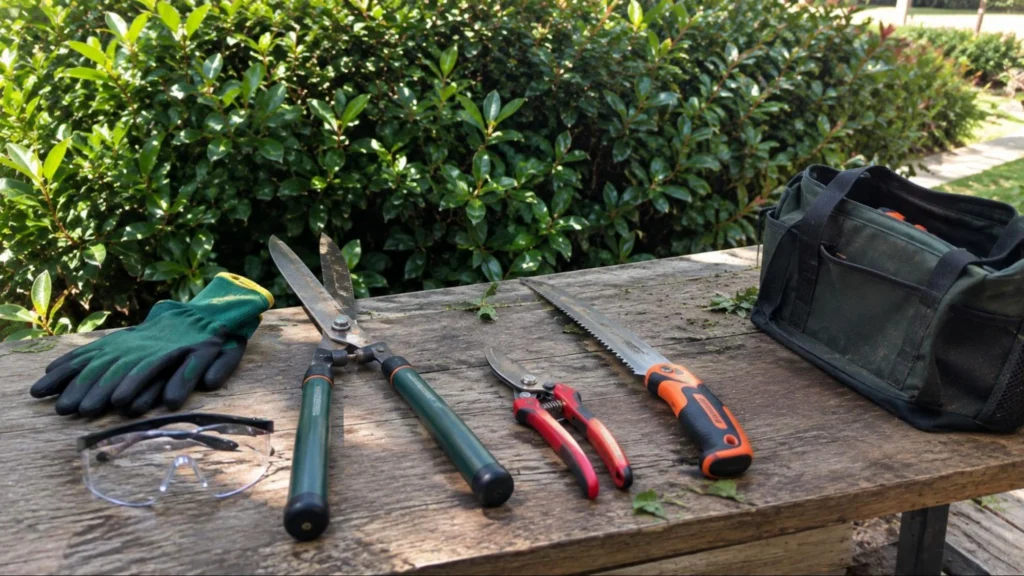
Most small shrub-maintenance jobs can be handled with clean hand pruners, loppers, and appropriate hedge shears, but the tool should match the size and type of growth being removed.
A basic homeowner kit may include:
- Hand pruners: Small branches and selective cuts
- Loppers: Larger branches within safe ground-level reach
- Hedge shears: Formal hedge shaping
- Pruning saw: Larger woody stems
- Gloves: Hand protection
- Eye protection: Protection from branches and debris
Keep your tools clean and sharp.
Clean, properly maintained equipment makes controlled cuts easier. Tool sanitation is also important when moving between plants because pruning equipment can spread pathogens.
Don’t Use A Ladder Just Because the Shrub Is Too Tall
This is one of the most important DIY limitations.
If the only way to reach the top of a shrub is to climb a ladder while holding pruning equipment, stop and reconsider the job.
A tall hedge beside a driveway, roof, wall, or power line creates a very different safety situation from a waist-high shrub in an open planting bed.
When Should You Hire a Professional for Bush Trimming?
Professional bush trimming makes sense when shrubs are large, severely overgrown, difficult to access, close to structures, or require species-specific pruning knowledge. For Central Florida homeowners who are unsure how to handle these situations safely, Native Tree of Central Florida can provide guidance and professional trimming services when needed.
You should consider professional help when:
- The shrub is too tall to safely reach from the ground
- You need a major reduction
- The hedge is extensive
- The plant is close to power lines
- Branches are growing into the roof or structure
- You cannot identify the plant
- The shrub has significant damage
- You are concerned about plant health
- The work requires ladders, specialized equipment, or multiple workers
For larger properties or extensive hedges, professional hedge trimming can help maintain the plants safely while preserving their intended shape and long-term health.
For homeowners in Ocala and throughout Central Florida, choosing a fully insured tree-care company with ISA-Certified Arborists is particularly important when the work goes beyond simple ground-level landscape maintenance.
Insurance matters because professional tree and landscape work can involve equipment, property, workers, and difficult working conditions.
Certification matters because pruning is not simply a matter of knowing how to operate a pair of shears. Understanding plant structure, growth, defects, and appropriate pruning practices helps professionals make better decisions.
How Can You Tell If a Bush Actually Needs Trimming?
A bush does not need to be perfectly round, square, or symmetrical to be healthy. Trim when there is a specific reason to do so, such as dead growth, structural problems, interference with the home, blocked access, excessive crowding, or a clearly defined landscape-maintenance goal.
Before trimming, ask four questions:
1. Is there a health problem?
Look for:
- Dead branches
- Broken stems
- Diseased growth
- Excessive crowding
2. Is the shrub interfering with something?
Check:
- Windows
- Walkways
- Driveways
- Fences
- Structures
- Utility access
- Visibility
3. Does the plant still fit its location?
A shrub that has outgrown its planting space may continue creating problems even after repeated trimming.
4. What happens after I cut it?
Think beyond today’s appearance.
- Will the shrub quickly grow back into the same problem?
- Will you remove flower buds?
- Will the interior become more shaded?
- Will the plant become dependent on repeated hard pruning?
Good shrub trimming considers what happens next, not just what the plant looks like immediately afterward.
Conclusion
Bush trimming can look simple until you’re faced with a large, overgrown shrub. For Central Florida homeowners, the warm, humid climate and long growing season can make shrubs grow quickly.
The goal isn’t to cut as much as possible. Proper trimming removes what needs to go while protecting healthy growth, maintaining shape, and keeping plants away from structures.
Small, accessible shrubs can often be maintained by homeowners, while large hedges, severely overgrown plants, difficult locations, ladders, or electrical hazards may require professional help. Native Tree of Central Florida provides professional tree and shrub care backed by fully insured service and ISA-Certified Arborists.
Need Professional Bush Trimming?
Keep your Central Florida landscape healthy and well-maintained with professional bush and shrub trimming from Native Tree of Central Florida.
Call us today at (352) 561-3626 or reach us via e-mail at sales@nativetreecf.com to schedule your professional tree service.
Frequently Asked Questions
How often should bushes be trimmed in Central Florida?
There is no single schedule for every shrub. Fast-growing plants may need more frequent maintenance, while slower-growing shrubs may need much less. Species, location, desired appearance, and flowering cycle should all be considered.
Should bushes in front of a house touch the walls?
Ideally, shrubs should have adequate clearance from the home’s exterior rather than growing directly against it. UF/IFAS recommends approximately 12 to 18 inches of clearance for many shrub-and-structure situations, although the appropriate distance can vary by plant and location.
Should hedges be wider at the bottom?
Yes. A formal hedge is generally healthier-looking when the bottom is wider than the top because more sunlight can reach the lower foliage.
Can I cut an overgrown bush all the way down?
Not necessarily. Severe pruning may be inappropriate for some shrubs and can produce weak structure, sparse growth, or unnecessary stress. The correct approach depends on the species, condition, and amount of growth that needs to be removed.
What should I do if I don't know what kind of bush I have?
Identify the plant before making major cuts. Different shrubs have different growth habits and flowering cycles, so species identification can help determine where and when pruning should occur.