

Key Takeaways
- Central Florida’s rainy season generally develops in late May and continues into early/mid-fall, with the wettest period typically occurring through summer.
- More rain does not automatically mean healthier palms. Irrigation may need to be reduced or adjusted when rainfall is sufficient.
- Central Florida’s sandy soils drain quickly, but localized poor drainage can still leave roots saturated.
- Rain, humidity, and persistently wet foliage can increase conditions favorable to certain palm diseases.
- The rainy season is not a reason to aggressively prune palms. Healthy green fronds should generally remain.
- Nutrient deficiencies can become more noticeable because heavy rainfall can leach nutrients from soil.
- Heavy rain and thunderstorms make regular palm inspections especially important, particularly for broken fronds, leaning, crown damage, and exposed roots.
Caring for palm trees during the rainy season in Central Florida starts with understanding how heavy rainfall affects watering, drainage, nutrition, pruning, and storm-related risks.
The most important rainy-season tree care steps are to adjust irrigation, monitor drainage, watch for nutrient or disease symptoms, avoid unnecessary pruning, inspect palms after severe weather, and address safety concerns before they become emergencies.
For homeowners in Ocala and throughout Central Florida, understanding these seasonal changes can help keep palms healthier while preventing unnecessary damage and maintenance costs.
Table of Contents
When Is the Rainy Season in Central Florida?
Central Florida’s rainy season generally begins in late May or early June and continues into the fall, although the exact timing varies from year to year. The heaviest and most consistent rainfall typically occurs during the summer months.
This seasonal shift matters because palm trees experience very different growing conditions once frequent afternoon thunderstorms and high humidity arrive. Warm temperatures encourage growth, while regular rainfall increases soil moisture and can change how often supplemental irrigation is necessary.
In Ocala and surrounding Central Florida communities, homeowners should think of rainy-season care as an adjustment rather than a completely different maintenance program.
What to do: Start monitoring rainfall, irrigation, drainage, and palm condition as the wet season approaches instead of following the same watering schedule year-round.
Should You Water Palm Trees During the Rainy Season?
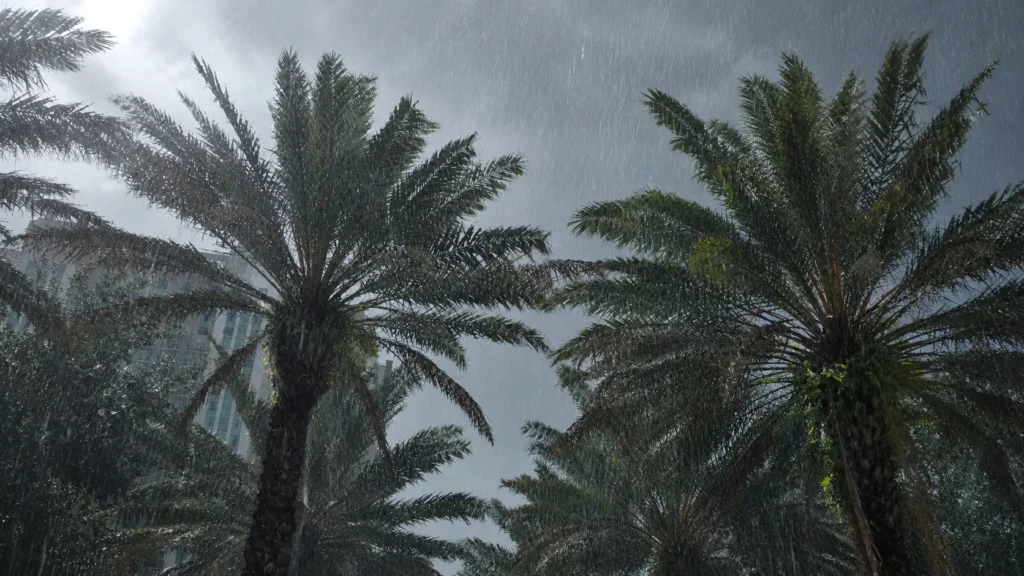
Usually, you should adjust irrigation based on actual rainfall rather than continuing a fixed watering schedule. If your palms are already receiving sufficient natural rainfall, additional irrigation may contribute to unnecessarily wet soil.
Palm roots need both water and oxygen. Soil that remains saturated for extended periods can limit oxygen around the roots and contribute to root stress. This is particularly important in areas of a Central Florida property where drainage is slower than expected.
Sandy soils are common throughout the region and can drain quickly, but that does not mean every part of a landscape drains equally. Compacted areas, low spots, poorly graded beds, or heavy irrigation can still create wet conditions around roots.
Rainy-season watering checklist
- Check recent rainfall before running irrigation.
- Inspect the soil around the palm rather than watering automatically.
- Pay attention to low areas where water collects.
- Make sure irrigation heads are not constantly soaking the palm or its root zone.
- If your irrigation system runs automatically, check whether its schedule is still appropriate when regular rainfall is already providing moisture.
- Reduce unnecessary irrigation when rainfall is already providing adequate moisture.
- Investigate persistent soggy soil instead of assuming the palm simply needs less water.
Professional insight: Yellowing leaves do not automatically mean a palm needs more water. Nutrient deficiencies, root stress, disease, and other problems can produce similar symptoms. Treating the symptom without identifying the cause can make the problem worse.
How Does Heavy Rain Affect Palm Tree Health?
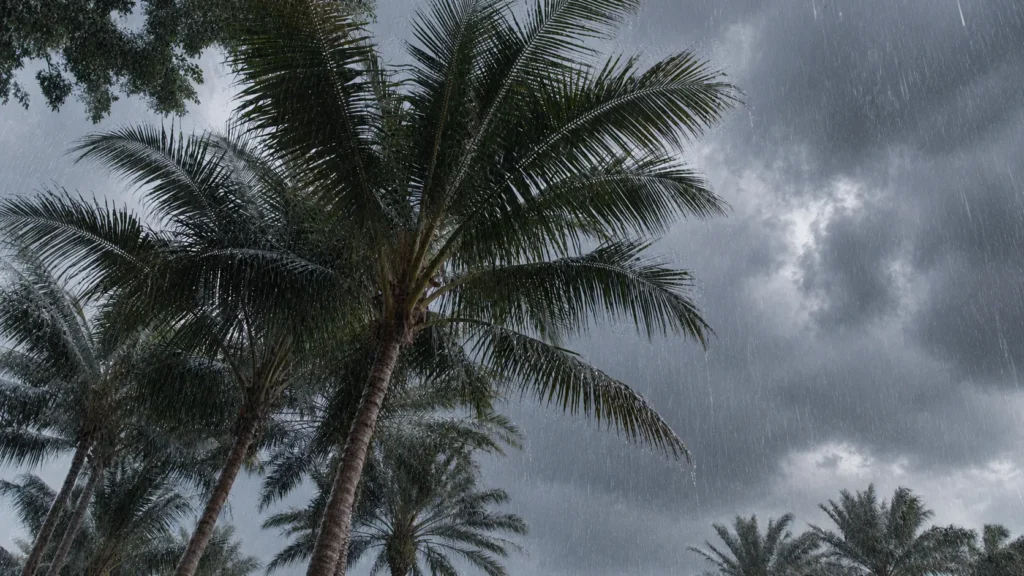
Heavy rain can benefit palms by supplying moisture during Florida’s hot growing season, but prolonged wet conditions can also create problems with roots, nutrients, and disease.
Heavy rainfall can move soluble nutrients through the soil, while continuously wet foliage can create favorable conditions for some leaf diseases. UF/IFAS guidance notes that certain palm leaf-spot pathogens can spread through rain and that water management and sanitation are important parts of disease management.
Humidity adds another layer. Central Florida’s warm, humid weather can create conditions where certain palm diseases and other plant-health problems deserve closer monitoring.
Watch for changes such as:
- Unusual spotting on palm fronds
- Rapid or widespread browning
- Declining new growth
- Persistent yellowing
- A damaged or declining central spear
- Unusual crown symptoms
- Soil that stays saturated for long periods
- Sudden decline after severe weather
One brown frond by itself does not necessarily mean a palm is diseased. The pattern, location, progression, and condition of the entire palm matter.
What to do: If symptoms continue to spread or the growing point appears affected, have the palm evaluated rather than applying a random fungicide or fertilizer.
Do Palm Trees Need Fertilizer During the Rainy Season?
Palm fertilization should be based on the species, soil conditions, visible symptoms, and an appropriate fertilization program rather than simply adding fertilizer because summer rains have arrived.
Heavy rainfall can contribute to nutrient leaching, and palms growing in Florida’s sandy soils may develop nutrient deficiencies. Yellowing or discoloration can sometimes indicate a nutrient deficiency, but the pattern and location of the symptoms matter.
Fertilizer rules can vary by municipality, so homeowners in Ocala and surrounding Central Florida communities should check current local restrictions before applying fertilizer during the rainy season.
A better approach is to:
- Identify the palm species when possible.
- Examine the pattern of discoloration.
- Consider soil and drainage conditions.
- Review previous fertilization.
- Check local fertilizer regulations.
- Use a palm-appropriate fertilizer program when appropriate.
Professional insight: More fertilizer is not automatically better. Applying the wrong product or excessive nutrients can create additional problems. If you cannot determine whether yellowing is caused by nutrition, water, disease, or another issue, diagnosis should come before treatment.
Should You Prune Palm Trees During the Rainy Season?
Rainy season does not mean palm trees should be aggressively pruned. Healthy green fronds generally contribute to the palm’s ability to produce energy, so removing healthy foliage simply to make a palm look cleaner can weaken the plant.
This is especially important before or during storm season. Stripping a palm of healthy fronds does not make it storm-proof. In fact, drastic pruning can create unnecessary stress.
Appropriate pruning generally focuses on genuinely dead, broken, or hazardous material rather than removing healthy green leaves.
Avoid these common mistakes:
- Removing healthy green fronds
- Cutting the canopy into an unnatural shape
- Performing a drastic “hurricane cut”
- Pulling off fronds prematurely
- Cutting into living trunk tissue
- Attempting tall palm pruning from an unstable ladder
Professional insight: Palm pruning is not the same as pruning a typical hardwood tree. Palms have a different growth structure, and damage to their central growing point can be especially serious.
If a palm is too tall to safely reach from the ground, is close to power lines or structures, or has damaged material that could fall, professional tree care is the safer option.
How Should You Check Palm Trees During Florida’s Rainy Season?
During Central Florida’s rainy season, homeowners should regularly inspect palm trees for broken fronds, crown damage, leaning, and other visible changes after heavy rain and thunderstorms. A quick ground-level inspection can help identify problems before damaged palm material becomes a safety hazard.
Frequent summer storms can leave palms with broken or hanging fronds, damaged crowns, or other visible signs of stress. Checking the palm after severe weather is especially important when it is located near a home, driveway, road, or other area where falling material could cause damage.
After heavy rain or a strong storm, look for:
- Broken or hanging palm fronds
- Damage around the crown
- A newly leaning trunk
- Severe or unusual trunk damage
- Fronds resting on a roof, vehicle, fence, or other structure
- Loose palm material that could fall
- Other changes that appeared immediately after the storm
If electrical hazards are present, stay away. Downed power lines, damaged structures, unstable trees, and hanging tree material can create serious safety risks.
You also do not need to remove a healthy palm simply because it experienced storm stress. The appropriate response depends on the type, severity, and location of the damage.
Professional insight: If the damage is overhead, the palm is unstable, or it is located near a home, vehicle, road, or utility line, avoid climbing or attempting to remove the damaged material yourself. If you notice significant leaning, crown damage, or hazardous hanging material, a professional assessment can help determine whether the palm needs pruning, monitoring, or additional care.
For homeowners in Ocala and throughout Central Florida, making a quick ground-level inspection after major storms is a simple way to catch rainy-season problems early while keeping palm care focused on health and safety.
Why Is Drainage Important for Palm Trees in Ocala?
Drainage matters because healthy palm roots need access to both moisture and oxygen. Even though Central Florida is known for sandy soils and relatively fast drainage, individual properties can have compacted soil, low areas, grading problems, or irrigation patterns that keep water around the root zone longer than expected.
A palm growing in a naturally well-drained area may respond very differently to heavy rainfall than one planted in a low section of the yard where water collects.
What should you check after heavy rain?
Look at how water behaves around the palm rather than simply asking whether the tree received enough rain. Watch for:
- Standing water around the root zone
- Soil that remains saturated long after nearby areas dry
- Water consistently collecting in the same area
- Erosion that is washing soil away from the root zone
- Soil movement after heavy rainfall
- Irrigation adding water to an area that is already saturated
Don’t automatically pile soil around an exposed palm trunk. Covering the trunk or changing the soil grade without addressing the underlying drainage or erosion problem can create additional problems.
Local insight: Central Florida properties can vary considerably even within the same neighborhood. Soil type, grading, irrigation, nearby construction, and landscape design can all influence how water behaves around a palm.
If an area repeatedly stays saturated after rainfall, the solution may involve correcting drainage or irrigation rather than simply reducing watering for the palm.
A Simple Rainy-Season Palm Care Checklist
Use this checklist throughout the wet season:
What to Check | What Homeowners Should Do |
Rainfall | Adjust irrigation instead of watering automatically |
Soil | Look for prolonged saturation, standing water, or erosion |
Fronds | Watch for unusual browning, spotting, or rapid decline |
Nutrients | Investigate yellowing before applying fertilizer |
Pruning | Remove only appropriate dead, broken, or hazardous material |
Storm readiness | Inspect palms before severe weather |
After storms | Look for broken fronds, leaning, crown, or trunk damage |
Safety | Stay on the ground when hazards are overhead |
Professional care | Schedule an assessment when damage or decline is unclear |
Rainy-season palm care is ultimately about balance. Palms need water, but not permanently saturated roots. They need pruning, but not excessive pruning. They benefit from nutrients, but not indiscriminate fertilizer. And they need storm preparation, but not drastic canopy removal.
For Central Florida homeowners, paying attention to these details can make seasonal palm maintenance more effective and prevent small concerns from becoming expensive problems.
Conclusion
Caring for palm trees during the rainy season in Central Florida means adjusting irrigation, monitoring drainage, watching for disease and nutrient problems, avoiding unnecessary pruning, and inspecting palms after heavy storms.
Monitor rainfall before irrigating. Watch how water moves through your landscape. Look for changes in fronds and new growth. Avoid unnecessary pruning, especially drastic hurricane cuts. Check palms after severe storms, and do not attempt hazardous work from ladders or around power lines.
Ocala’s warm climate, humidity, seasonal storms, and sandy soils give palm trees excellent growing conditions, but those same conditions require thoughtful maintenance.
The goal is not simply to make a palm look neat. It is to keep the tree healthy, structurally sound, and appropriate for the space around it.
Keep Your Palm Trees Healthy Through Florida’s Rainy Season
Protect your palms from storm damage and excess moisture with professional tree care from Native Tree of Central Florida. Contact our team today to keep your landscape healthy and storm-ready.
Call us today at (352) 561-3626 or reach us via e-mail at sales@nativetreecf.com to schedule your professional tree service.
Frequently Asked Questions
Can too much rain hurt palm trees?
Yes. Excessive or prolonged rainfall can contribute to saturated soil, reduced oxygen around the roots, nutrient leaching, erosion, and conditions that favor certain palm diseases. The risk depends on the palm’s location, soil, drainage, and how long the soil remains wet.
How often should I inspect my palm trees during Florida's rainy season?
Inspect your palms periodically throughout the rainy season and check them again after strong thunderstorms or periods of heavy rainfall. The frequency depends on the palm’s condition, location, height, and exposure to storms.
Should I turn off my irrigation system during Florida's rainy season?
Not necessarily, but your irrigation schedule may need to be reduced or adjusted when rainfall is providing enough moisture. Automatic irrigation systems can continue watering even after substantial rain, so homeowners should check recent rainfall and soil conditions rather than relying on the same schedule used during drier periods.
Can heavy rain wash nutrients away from palm trees?
Yes. Frequent heavy rainfall can contribute to nutrient leaching, particularly in sandy soils. If a palm develops yellowing or other signs of nutrient deficiency, identify the likely cause before applying fertilizer because similar symptoms can also result from water stress, root problems, disease, or other conditions.