

Key Takeaways
- Healthy palm trees need more than occasional trimming. Check the canopy, fronds, trunk, growing point, soil, and surrounding area regularly.
- Central Florida’s heat, humidity, sandy soil, heavy rainfall, and severe storms can all affect palm health.
- Yellowing, browning, poor growth, trunk changes, leaning, pests, disease, or storm damage deserve attention rather than automatic pruning.
- Avoid “hurricane cuts” that remove most healthy green fronds. Excessive pruning can weaken palms and increase their vulnerability to storm damage.
- Palm care should be based on the species, condition, location, and actual need, not an automatic trimming schedule.
- Tall, storm-damaged, unstable, or difficult-to-access palms should be evaluated by an experienced, insured tree professional.
Palm trees can make a Central Florida yard feel instantly more inviting, but their tropical appearance can make them seem easier to maintain than they really are. Good palm tree care means paying attention to the whole plant, not simply calling for a trim when the fronds look untidy.
For homeowners in Ocala and throughout Central Florida, that means looking at your palms regularly and noticing changes before a small maintenance issue becomes a larger tree health or safety concern.
So, have you looked at your palms lately?
Not just from the driveway. Walk around them. Look up into the canopy. Check the trunk and soil around the base. What you see can tell you quite a bit about how the palm is doing.
Table of Contents
What should you look for when checking a palm tree?
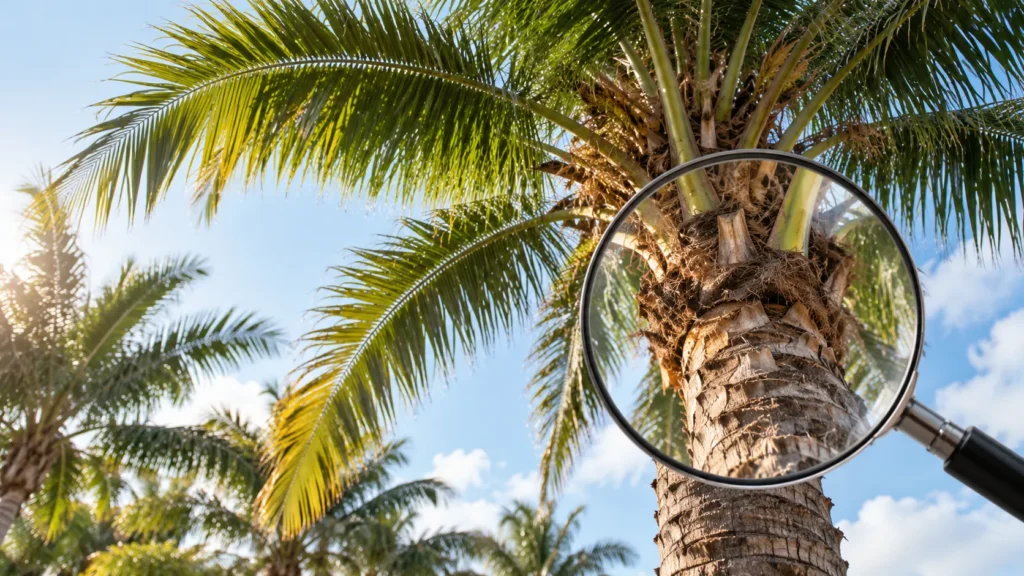
A simple palm inspection is one of the most practical tree care tips homeowners can use to stay ahead of potential problems. Check the canopy, fronds, trunk, growing point, soil, and surrounding area for changes in health, moisture, nutrient availability, stability, or storm damage.
A simple inspection includes:
- Look at the fronds. Check for unusual yellowing, browning, spotting, or premature decline.
- Check for dead material. Completely dead or damaged fronds may need removal when they create a safety concern.
- Examine the trunk. Look for cracks, decay, unusual damage, leaning, or movement.
- Check the growing point. New leaves emerge from the palm’s central growing point, making it critical to overall health.
- Inspect the soil. Central Florida’s sandy soils can drain quickly, while poorly drained areas may remain wet after heavy rain.
- Look around the palm. Consider whether falling fronds or damaged material could reach a roof, vehicle, walkway, or other high-use area.
What does the color of palm fronds tell you?
Yellow or brown fronds do not automatically mean a palm needs trimming. Discoloration can be related to normal aging, environmental stress, nutritional problems, or other issues depending on the species and symptom pattern.
Before removing a discolored frond, consider:
- Is the entire frond brown or only part of it?
- Is new growth affected?
- Are several palms showing similar symptoms?
- Did the change follow drought, heavy rain, a storm, or another landscape change?
The pattern can provide more useful information than simply deciding that the palm “needs a haircut.”
How to Care for Palm Tree Health in Central Florida
Learning how to care for palm tree health in Central Florida starts with regular observation and consistent maintenance. Homeowners should consider the palm’s species, growing conditions, soil, drainage, irrigation, and seasonal weather.
Proper care includes:
- Watering according to soil conditions and recent rainfall
- Monitoring foliage and new growth
- Providing appropriate nutrition
- Removing genuinely dead or hazardous material when necessary
- Avoiding unnecessary pruning
- Watching for pests, disease, and structural concerns
- Checking palms after severe weather
More water is not always better. A palm growing in well-drained sandy soil may have very different needs from one growing in a poorly drained part of the yard.
The goal is to respond to what the palm and its growing environment actually need rather than following a rigid maintenance schedule.
How does Central Florida’s climate affect palm tree health?
Central Florida’s heat, humidity, intense sun, rainfall, sandy soils, and seasonal storms can expose palms to different stresses throughout the year.
What role does sandy soil play in palm care?
Sandy soil can drain quickly, making moisture management important. However, excessive irrigation or poor drainage can also create problems.
When evaluating watering needs, consider:
- Soil conditions
- Recent rainfall
- Palm species
- Drainage
- Season
- Existing irrigation
A palm struggling because of its growing conditions may not improve simply because its fronds have been trimmed.
Do Different Types of Palm Trees Need Different Care?
Different types of palm tree can have very different growth habits, pruning needs, environmental tolerances, and maintenance requirements. A palm that thrives in one part of a Central Florida landscape may have different needs from another species.
Some palms naturally shed old fronds, while others retain them. Species can also differ in their tolerance of environmental conditions and their response to storm damage.
That is why identifying the palm before establishing a care or pruning routine can help homeowners make better maintenance decisions.
How can you tell if a palm may have a nutrient problem?
Unusual yellowing, poor growth, or changes in new and old fronds can indicate a nutritional problem, but symptoms need to be interpreted in context.
Before applying fertilizer, consider:
- Is new growth developing normally?
- Are several palms showing similar symptoms?
- Are older fronds affected first?
- Has irrigation or drainage changed?
- Has the palm experienced drought, flooding, transplanting, or storm stress?
Guessing at a nutrient problem and applying fertilizer without understanding the cause can waste money and potentially create additional problems.
Native Tree of Central Florida provides customized tree and shrub fertilization based on plant species, soil conditions, and landscape needs.
What should you do if a palm is damaged by a storm?
After severe weather, stay away from visibly unstable palms and damaged areas until they can be safely assessed. Look for broken or hanging fronds, trunk damage, leaning, uprooting, or possible damage to the growing point.
The growing point, or apical meristem, is critical because new leaves develop from it. Severe damage to this area can ultimately kill a palm.
After a major storm:
- Keep people and pets away from hazardous areas.
- Do not climb the palm to inspect damage.
- Do not pull hanging fronds from a tall palm.
- Look for obvious trunk or root damage from a safe distance.
- Have serious damage evaluated professionally.
A storm-damaged palm does not automatically need to be removed. The appropriate response depends on the extent and location of the damage.
When should you call a professional for palm tree service?
Professional palm tree service makes the most sense when a palm is tall, difficult to access, close to structures or power lines, storm-damaged, leaning, or showing unexplained decline.
DIY work becomes especially risky when it involves:
- Tall palms
- Ladders or elevated work
- Chainsaws or power equipment
- Hanging or heavy fronds
- Storm-damaged palms
- Unstable or leaning trees
- Work near roofs, vehicles, or power lines
The goal of professional care should not simply be to remove as much material as possible. It should be to determine what actually needs to be removed and what should remain.
Native Tree of Central Florida provides palm and tree pruning, tree removal, stump grinding and removal, fertilization, mulching, tree risk assessment, certified arborist consultation, emergency services, and debris removal throughout Central Florida.
Because palm work can involve elevated equipment, falling material, and work around structures, homeowners should also verify that their tree service is properly insured and qualified. Native Tree of Central Florida is fully licensed and insured, and our team includes ISA-Certified Arborists and trained tree-care professionals.
What is the simplest palm tree care checklist for Ocala homeowners?
Walk around your palms regularly and check their foliage, trunk, growing point, soil, and surroundings before deciding that they need trimming.
Palm Health Check
☐ Are the fronds mostly green and healthy?
☐ Are there completely dead or broken fronds?
☐ Is unusual yellowing or browning appearing?
☐ Is new growth developing normally?
☐ Does the trunk look stable and undamaged?
☐ Is the palm leaning or showing signs of movement?
☐ Is the soil excessively wet or unusually dry?
☐ Are there signs of pests, disease, or decay?
☐ Is anything hanging over your roof, driveway, or walkway?
☐ Has the palm recently experienced storm damage?
☐ Is the palm too tall or difficult to maintain safely from the ground?
If something looks different from the way it normally does, do not assume the solution is simply more pruning.
Conclusion: Healthy Palms Start With Paying Attention
Palm care is about much more than maintaining a neat-looking canopy. Healthy palms benefit from appropriate pruning, suitable growing conditions, proper nutrition, and timely attention when something changes.
The next time you walk through your Ocala yard, take a few minutes to look closely at your palms. Check the fronds, trunk, growing point, soil, and surrounding area. Pay particular attention after heavy rain or severe weather.
Most importantly, resist the temptation to cut first and ask questions later.
When you are unsure what your palm is telling you, Native Tree of Central Florida can help determine whether the best next step is maintenance, treatment, monitoring, or professional tree service.
Give Your Palm Trees the Care They Deserve
Keep your palms healthy, beautiful, and safe with professional palm tree care from Native Tree of Central Florida. Contact our team today to schedule your tree service in Ocala and surrounding areas.
Call us today at (352) 561-3626 or reach us via e-mail at sales@nativetreecf.com to schedule your professional tree service.
Frequently Asked Questions
What is the best way to care for palm trees in Central Florida?
The best approach is to match care to the palm’s species, growing conditions, and current health. Monitor the fronds and new growth, maintain appropriate soil moisture, provide proper nutrition when needed, and avoid unnecessary pruning. Central Florida’s sandy soils, heavy rainfall, heat, and seasonal storms can all affect palm health.
How do I know if my palm tree needs professional attention?
A palm deserves professional evaluation when it is tall or difficult to access, leaning, storm-damaged, showing unexplained decline, or located close to a home, driveway, walkway, or power line. Professional assessment can help determine whether the palm needs pruning, treatment, monitoring, or removal.
Can overwatering damage a palm tree?
Yes. Although palms need adequate moisture, excessive irrigation or poor drainage can create unhealthy root conditions. Watering should take into account recent rainfall, soil type, drainage, palm species, and existing irrigation. In Central Florida, sandy soil may drain quickly, while compacted or poorly drained areas can retain water longer.
How long can a healthy palm tree live?
Palm lifespan varies considerably by species and growing conditions. Some palms can live for decades when planted in suitable conditions and properly maintained. Because different species have different growth rates, mature sizes, and environmental tolerances, identifying the palm is important when estimating its expected lifespan.
What should I do if I don't know what type of palm tree I have?
Start by looking at the palm’s overall shape, trunk characteristics, frond structure, and growth pattern. If identification is uncertain, an experienced tree professional can help determine the species and evaluate its condition. Correct identification can make it easier to establish appropriate pruning, watering, nutrition, and maintenance practices.